
Ideas
A studio for one dependable workflow at a time
A focused service concept for turning one recurring operations task into a supervised, maintainable workflow.
By Michael Santiago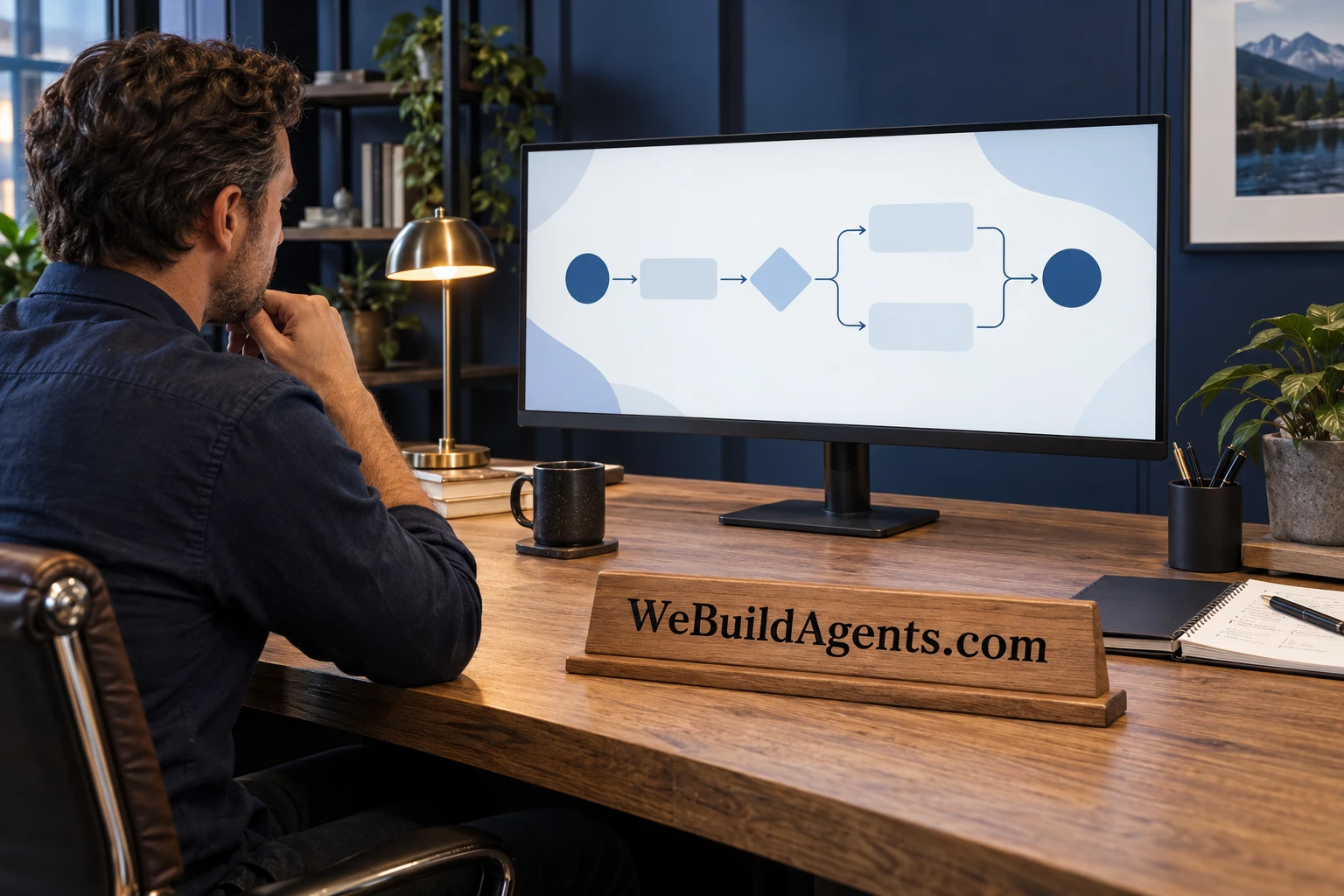
A small operations team may know exactly where its day gets stuck. Requests arrive in different formats, someone copies details into a system, and another person checks whether anything is missing. The team does not necessarily need a company-wide agent strategy. It needs a useful improvement to that particular stretch of work.
A possible business for WeBuildAgents.com is an implementation studio built around those bounded assignments. The concept below is illustrative: a service that maps one workflow, builds a limited assistant and leaves the customer with clear operating responsibilities. I would make the first offer easy to describe before trying to make it broad.
Sell a defined handoff
The initial customer could be an operations manager at a small business with recurring internal requests. Consider a facilities team receiving maintenance reports from staff. The proposed agent reads each submission, identifies missing details and prepares a structured record for a coordinator. A person still decides the priority and assigns the job.
The studio's offer could cover discovery, a prototype using agreed sample records, a supervised trial and a handover package. The deliverable would be the working flow plus the instructions needed to operate it. Write the boundaries into the proposal: which inbox or form is included, what counts as an eligible request and which actions need review.
This turns a vague purchase into a concrete comparison. The customer can ask whether the proposed record contains the fields the coordinator needs. It can also see what remains its own responsibility, including access approvals, policy decisions and final dispatch. A demonstration becomes more useful when everyone knows the exact point at which the software stops.
Understand the work before choosing the tool
Start discovery with a person who handles the requests today. Ask them to walk through a normal case, an incomplete case and a case they would immediately send to a colleague. Record the information available at each step. Pay attention to the informal rules, such as which building names refer to the same location or which requests require a photograph.
Anthropic's discussion of building effective agents distinguishes predefined workflows from systems that choose their own steps and tools. That distinction is useful here: use a fixed sequence when the task already has a clear route. The proposed studio should be willing to recommend a simple form change or ordinary automation when that would solve the customer's problem.
For the facilities example, the first prototype could accept a saved request, extract a few fields and produce a draft record. It need not access the live maintenance system. That smaller version gives the coordinator something specific to judge before the studio requests broader access.
Define acceptance with the customer
Build a sample pack together. Include readable reports, missing locations, duplicate submissions and requests outside the service's scope. For each case, write what an acceptable output would contain. Avoid treating a fluent paragraph as proof of correct work. A polished response that assigns the wrong building is still a failed case.
A practical acceptance sheet might contain the original request, the prepared record, the expected review route and a place for the coordinator's decision. Keep rejected examples as well as successful ones. A rejection often reveals an unstated rule that should become part of the operating instructions.
Agree on the trial's stopping conditions before it starts. For instance, an unexpected attempt to change a live record should pause the pilot. So should repeated failure to identify an essential field. These are proposed controls for this example, and the actual customer should set its own limits according to the work involved.
Make maintenance part of the offer
Someone must own the workflow after delivery. The studio could offer a separate maintenance arrangement, but the handover should remain useful even if the customer declines it. Include a description of the connections, the account owner for each tool, the test cases and instructions for pausing the process.
Changes deserve a route too. A newly required form field, a revised internal policy or a different ticket system can affect the result. Ask the customer to nominate one person who can approve those changes. The studio can then distinguish a repair from a new feature instead of renegotiating expectations during an incident.
For the illustrative facilities team, a monthly review might examine a small sample of prepared records and any cases sent to a person. The purpose would be to find changes in the work, not to manufacture a dashboard full of favorable numbers. Charge for a defined review activity only if the service can actually provide it.
Find customers through a recognizable problem
One credible distribution path would be a practical demonstration for operations managers in a single business category. Show a fictional incoming request, the prepared record and the coordinator's review screen. Explain the scope in plain language. Invite prospects to describe a similar bottleneck without asking them to disclose sensitive records in public.
WeBuildAgents.com fits this concept because the phrase can introduce a team that makes something for a customer. The offer would still need a sharper subtitle identifying the first workflow and customer group. That specificity belongs in the service description, where it can change as the studio learns.
The next step is a one-page map of one repetitive task: trigger, inputs, proposed output, reviewer and stopping point. If that map holds together, it becomes the basis for a discovery conversation. To explore acquiring WeBuildAgents.com for this kind of studio, use the domain inquiry form and describe the service you intend to develop.